
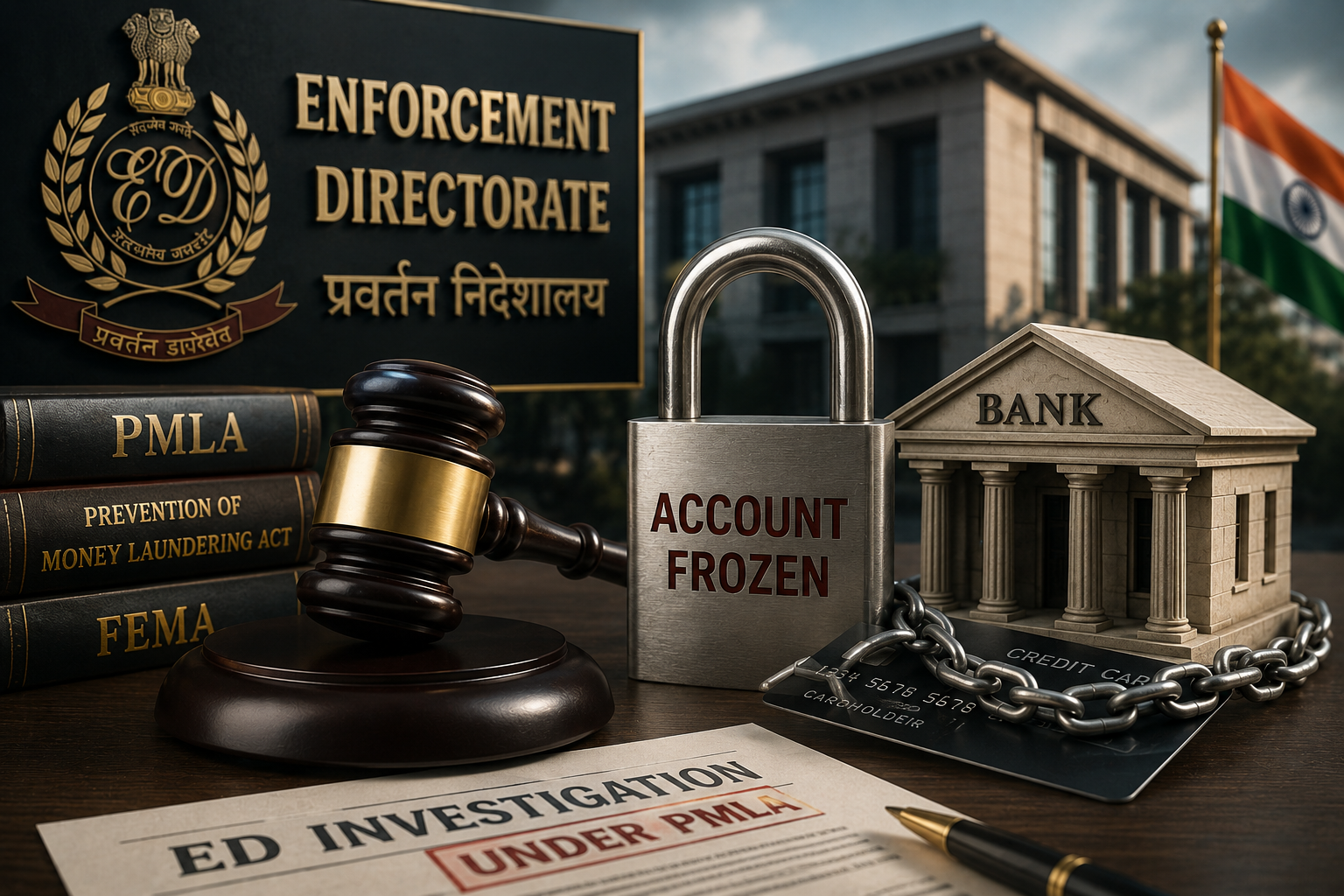
Financial investigations conducted by the Enforcement Directorate (ED) can have serious consequences for individuals and businesses. One of the most concerning actions taken during an investigation is the freezing of bank accounts. For many people the sudden inability to access personal or business funds can create significant financial and legal challenges.
If you are facing an Enforcement Directorate investigation or have received information that your bank account has been frozen, it is important to understand the legal framework, your rights and the remedies available under Indian law. Knowing how the process works can help you respond effectively and protect your interests.
What Is the Enforcement Directorate?
The Enforcement Directorate (ED) is a specialized financial investigation agency under the Government of India. It is responsible for enforcing laws related to financial crimes, foreign exchange violations and money laundering.
The agency primarily investigates cases under:
- The Prevention of Money Laundering Act, 2002 (PMLA)
- The Foreign Exchange Management Act, 1999 (FEMA)
The Enforcement Directorate has wide-ranging powers to investigate financial transactions, summon individuals, examine records, conduct searches, attach properties and take action against assets believed to be linked to criminal activities.
Can the Enforcement Directorate Freeze a Bank Account?
Yes, the Enforcement Directorate has the authority to freeze bank accounts during the course of an investigation when it believes that the funds may be connected to proceeds of crime or money laundering activities.
The purpose of freezing an account is to prevent the movement, transfer or withdrawal of funds that may be relevant to an ongoing investigation.
A frozen bank account generally means that the account holder cannot withdraw, transfer or utilize the funds without legal authorization.
Under What Circumstances Can ED Freeze a Bank Account?
The Enforcement Directorate may take such action in situations involving:
Alleged Money Laundering Activities
If authorities suspect that funds in a bank account are derived from criminal activities the account may be frozen pending investigation.
Financial Fraud Investigations
Cases involving large-scale fraud, corporate misconduct, embezzlement or financial irregularities often attract scrutiny from enforcement agencies.
Suspicious Financial Transactions
Unusual transfers, unexplained deposits or transactions linked to individuals or entities under investigation may lead to account restrictions.
Attachment Proceedings Under PMLA
Where authorities believe that funds constitute proceeds of crime, provisional attachment or freezing measures may be initiated to preserve evidence and prevent dissipation of assets.
What Happens After a Bank Account Is Frozen?
A bank account freeze does not automatically mean that the account holder is guilty of any offence.
It is generally one step within a broader investigation process. After freezing an account, authorities may:
- Examine financial records.
- Review transaction histories.
- Summon individuals for questioning.
- Seek additional documentation.
- Investigate the source of funds.
- Assess potential links to alleged criminal activities.
The outcome depends on the evidence collected during the investigation.
Rights of Individuals During an ED Investigation
Many people assume that enforcement agencies possess unlimited authority. However, individuals and businesses continue to enjoy important legal protections during an investigation.
Right to Legal Representation
A person facing an Enforcement Directorate inquiry has the right to seek legal advice and assistance from an experienced lawyer.
Early legal guidance can help ensure compliance with legal requirements while protecting constitutional and procedural rights.
Right to Due Process
Any investigative action must follow procedures established by law. Authorities are required to act within the scope of their statutory powers.
Right to Challenge Adverse Actions
Individuals affected by account freezes, property attachments or other enforcement measures may challenge such actions through appropriate legal channels.
Right to Fair Treatment
Every person is presumed innocent until proven guilty. Investigations must be conducted fairly and in accordance with legal principles.
What Should You Do If Your Bank Account Is Frozen?
Receiving information about a frozen bank account can be alarming. However, taking the right steps at an early stage can significantly improve your legal position.
Remain Calm and Gather Information
Avoid making assumptions or taking hasty actions. Obtain relevant documents, notices, communications and banking records related to the matter.
Understand the Basis of the Action
Determine whether the account freeze is connected to a PMLA investigation, financial fraud inquiry or another enforcement proceeding.
Understanding the legal basis is essential before deciding on a response strategy.
Consult an Experienced Lawyer
Professional legal advice is critical in Enforcement Directorate matters. An experienced legal team can evaluate the facts, identify procedural issues and advise on available remedies.
Maintain Proper Documentation
Keep records of all financial transactions, contracts, tax filings, invoices and supporting documents that may help establish the legitimacy of funds.
Cooperate While Protecting Your Rights
Cooperation with lawful investigations is important. However, individuals should also ensure that their legal rights are properly protected throughout the process.
Legal Remedies Available Against ED Actions
The law provides several mechanisms for challenging actions taken during enforcement proceedings.
Representation Before Authorities
In certain situations, legal representations may be submitted to explain the source of funds or contest allegations.
Proceedings Before Adjudicating Authorities
Matters relating to attachment and seizure may be reviewed before designated adjudicating authorities under applicable laws.
Appeals Before Appellate Forums
Aggrieved parties may have the right to challenge adverse orders before appellate tribunals or other competent forums.
High Court Remedies
Where appropriate, legal remedies may also be pursued before constitutional courts to address procedural irregularities or violations of legal rights.
The availability of specific remedies depends upon the facts and circumstances of each case.
Common Mistakes to Avoid During an ED Investigation
Individuals often worsen their legal position by making avoidable mistakes.
Some common errors include:
- Ignoring notices or summons.
- Providing incomplete information.
- Destroying or concealing documents.
- Making false statements.
- Attempting unauthorized transfers of assets.
- Delaying legal consultation.
Prompt and informed action is usually the most effective approach.
Why Early Legal Advice Matters
Enforcement Directorate investigations can involve complex legal and financial issues. The consequences may extend beyond bank account restrictions and can affect businesses, reputations, investments and future financial activities.
Seeking legal advice at the earliest stage allows individuals and organizations to understand their rights, prepare appropriate responses and develop a strategic defense where necessary.
A proactive approach can often help prevent unnecessary complications and ensure compliance with legal requirements.
Conclusion
The Enforcement Directorate has significant powers to investigate financial crimes and, in appropriate cases, freeze bank accounts linked to suspected proceeds of crime. However such actions are subject to legal safeguards, procedural requirements and judicial scrutiny.
If your bank account has been frozen or you are facing an Enforcement Directorate investigation, understanding your legal rights is essential. Timely legal advice, proper documentation and a well-informed response can play a crucial role in protecting your interests and navigating the investigation process effectively.
FAQs
Can the Enforcement Directorate freeze a personal bank account?
Yes. If authorities believe that funds may be connected to alleged proceeds of crime or an ongoing investigation, personal accounts may be frozen.
Does a frozen bank account mean I am guilty?
No. A bank account freeze is an investigative measure and does not establish guilt.
Can I challenge the freezing of my bank account?
Depending on the circumstances, legal remedies may be available before appropriate authorities, appellate forums or courts.
Should I respond to an ED notice immediately?
Yes. Ignoring notices can create additional legal complications. Professional legal advice should be sought as soon as possible.
Can businesses be affected by ED investigations?
Yes. Companies, directors, partners and business entities may be subject to investigation where authorities suspect financial irregularities or money laundering activities.