
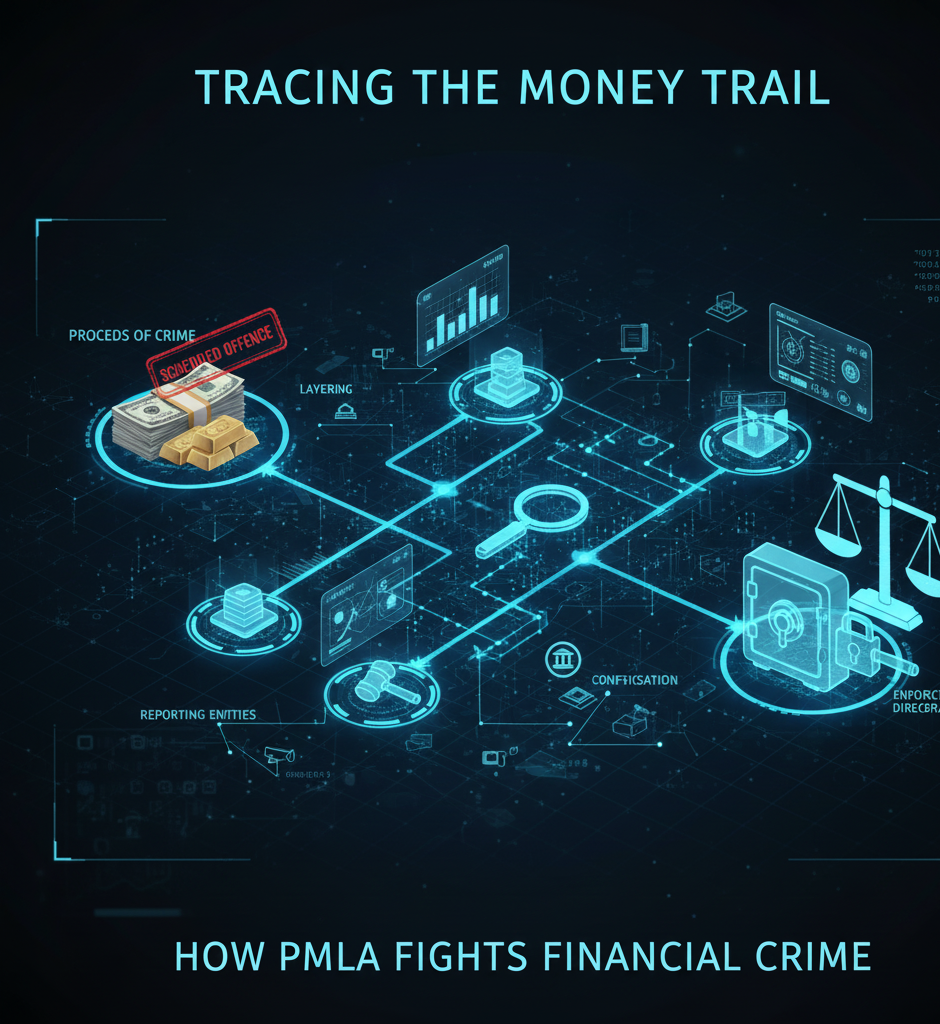
Tracing the Money Trail: How PMLA Fights Financial Crime
In a growing economy, financial crimes like money laundering pose a major threat to transparency and national security. To curb these illegal practices and monitor suspicious financial movements, India enforces the Prevention of Money Laundering Act (PMLA), 2002. This powerful legislation ensures that illicit money does not find a safe
Read More
Silent Crimes, Major Impact: The Challenge of White Collar Offences
White collar offences often occur behind polished office walls and through digital systems — without noise, without violence. Yet, their damage is far-reaching, capable of shaking financial stability, destroying public trust, and costing billions. These crimes are sophisticated, calculated, and committed by individuals in positions of power. What Are White
Read More
The Legal Weapon Against Money Laundering: PMLA Insights
Money laundering is a serious economic crime that threatens financial security and enables corruption, terrorism funding, and organized illegal activities. To combat this, India introduced the Prevention of Money Laundering Act (PMLA), 2002 — a comprehensive law designed to detect, prevent, and punish the conversion of unlawful proceeds into seemingly
Read More
Fraud Behind the Desk: The Truth About White Collar Crime
White collar crime is often silent, sophisticated, and hidden behind professional attire. Unlike traditional crimes, these offences are committed through deception rather than violence — yet their impact on the economy and society can be massive. From large-scale financial scams to digital frauds, White Collar Crimes are on the rise
Read More
The Silent Heist: Unveiling White-Collar Crimes
White-collar crimes are often described as the “silent heist.” Unlike traditional crimes that involve violence or visible theft, these offences quietly steal money, trust, and reputation. They are usually committed by individuals in positions of power—corporate executives, government officials, financial professionals, and business owners. Their weapons are not guns or
Read More
Crimes in Suits: Exposing the Hidden World of White-Collar Offences
White-collar crime is often called the “silent thief.” Unlike traditional crimes that involve violence or physical force, white-collar offences quietly steal money, trust, and integrity. These crimes are committed by individuals in positions of power—business owners, corporate officials, government employees, and financial professionals. Their tools are not guns or weapons
Read More
Guarding the Economy: The Role of PMLA in Financial Transparency
In an era where financial crimes are becoming increasingly sophisticated, maintaining transparency and accountability in the economy has become a national priority. One of India’s strongest legal weapons in this fight is the Prevention of Money Laundering Act (PMLA), 2002. Designed to curb the circulation of “dirty money,” the PMLA
Read More
Crime in the Boardroom: Understanding White-Collar Offences
In the world of corporate sophistication and financial success, not all crimes are committed in dark alleys or behind closed doors. Some are executed in well-lit boardrooms, by individuals in crisp suits and polished shoes. These are known as white-collar crimes — non-violent offences committed for financial gain through deceit,
Read More
PMLA Matters: Combating Financial Crime and Ensuring Legal Compliance
The rise in global financial transactions and cross-border investments has increased the risk of money laundering and financial crimes. To address this challenge, India enacted the Prevention of Money Laundering Act (PMLA), 2002, a comprehensive legislation aimed at detecting, preventing, and prosecuting money laundering activities while ensuring accountability and transparency
Read More
White-Collar Crime: Defending Reputation and Upholding Justice
White-collar crimes are non-violent offences committed for financial gain, often involving deceit, manipulation, or breach of trust. Such crimes typically occur in professional, corporate, or business settings and can lead to significant economic loss, reputational damage, and legal consequences. Understanding White-Collar Crime The term white-collar crime refers to offences committed
Read More