
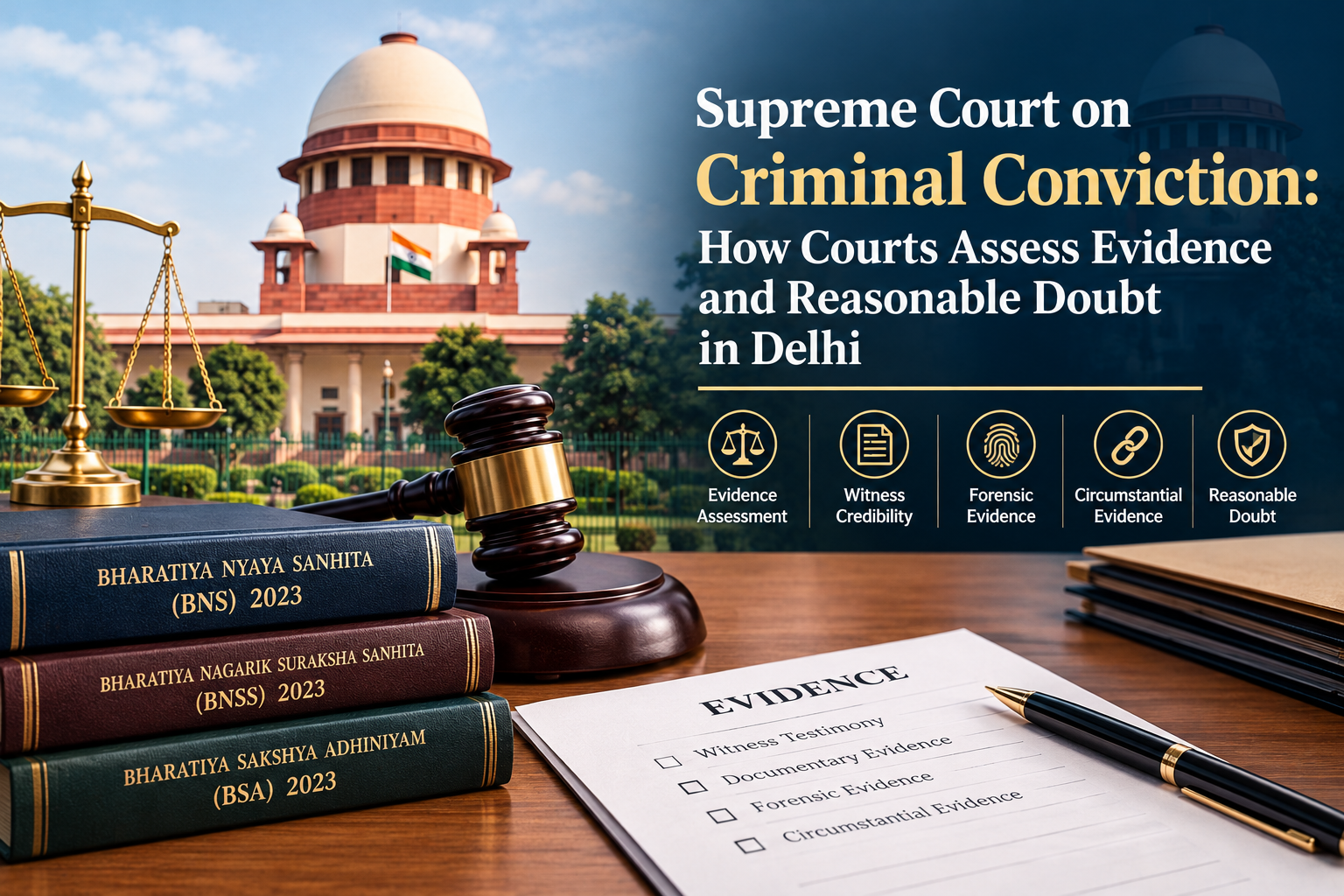
The Supreme Court on Criminal Conviction: How Courts Assess Evidence and Reasonable Doubt in Delhi is an important subject for understanding how Indian courts decide whether the prosecution has established the guilt of an accused person. In criminal proceedings, an allegation alone is not sufficient to justify a conviction. The court must examine the evidence, assess its reliability and determine whether the legal standard of proof has been satisfied.
The Indian criminal justice system recognises the presumption of innocence and requires the prosecution to prove its case beyond reasonable doubt. This standard protects individuals against wrongful conviction while allowing courts to reach findings based on reliable and legally admissible evidence.
The Supreme Court of India has repeatedly explained that reasonable doubt must arise from a fair assessment of the evidence. A merely imaginary possibility is not enough to defeat a prosecution case, but strong suspicion cannot replace proof. The court must evaluate the entire evidentiary record rather than rely on assumptions or isolated circumstances.
For individuals facing criminal charges, complainants and families dealing with criminal proceedings in Delhi, understanding these principles can help explain how convictions and appeals are assessed. This article discusses the legal standard of proof, witness testimony, documentary and forensic evidence, circumstantial evidence and the role of appellate courts.
For information about legal services, visit https://admaandassociate.com/.
Key Takeaways
- A criminal conviction generally requires the prosecution to establish guilt beyond reasonable doubt.
- The presumption of innocence is a fundamental principle of criminal jurisprudence.
- Courts assess witness credibility, documentary records, forensic material and other relevant evidence together.
- In cases based on circumstantial evidence, the circumstances must form a sufficiently complete chain pointing to guilt.
- Suspicion, however strong, cannot substitute for proof of the offence.
- An appeal against conviction requires examination of the relevant legal and factual grounds.
- Every criminal case depends on its particular evidence, applicable law and procedural history.
1. What Is the Legal Standard for Criminal Conviction in India?
A criminal court must determine whether the prosecution has proved the essential ingredients of the offence charged. The required standard is proof beyond reasonable doubt.
This does not mean that a court must eliminate every theoretical possibility or speculative doubt. Instead, the evidence must be sufficiently reliable and persuasive to establish guilt according to the criminal standard of proof.
The court considers the prosecution’s evidence as a whole, including whether important facts are established, whether witnesses are credible and whether material inconsistencies undermine the case.
Presumption of Innocence
The presumption of innocence means that an accused person is not to be treated as guilty merely because a complaint has been filed, an FIR has been registered or a charge has been framed.
The prosecution ordinarily carries the burden of proving the charge, subject to applicable statutory exceptions and specific legal presumptions. Where a statutory presumption applies, its scope and the requirements for rebuttal must be examined carefully.
Why Reasonable Doubt Matters
Reasonable doubt is an essential safeguard against wrongful conviction. If, after a fair evaluation of the evidence, a material and reasonable doubt remains about the accused person’s guilt, the criminal standard of proof has not been met.
However, a court does not have to accept every hypothetical alternative explanation. The doubt must be grounded in the evidence, the absence of relevant evidence or a genuine weakness in the prosecution’s case.
The Supreme Court has explained that reasonable doubt must be based on reason and common sense rather than vague apprehension or abstract speculation.
2. How Does the Supreme Court Assess Evidence in Criminal Cases?
Evidence is the foundation of a criminal trial. Courts examine the material placed on record to determine whether it proves the charge and whether it can legally support a conviction.
The assessment is not limited to counting witnesses or documents. The court must consider the quality, consistency, credibility and relevance of the evidence.
Witness Testimony
Witnesses may provide direct accounts of an incident, describe events before or after it, or explain other circumstances relevant to the case.
Courts may examine:
- Whether the witness had an opportunity to observe the event.
- Whether the testimony is consistent on material points.
- Whether important contradictions exist between statements and testimony.
- Whether the account is supported or contradicted by other evidence.
- Whether there are circumstances affecting the witness’s ability to recall or accurately describe events.
A minor discrepancy does not necessarily make a witness unreliable. Differences in recollection can occur naturally. The significance of a contradiction depends on its nature and its effect on the central issues in the case.
Similarly, a witness should not be rejected merely because they know one of the parties. The court must assess the testimony objectively and consider the circumstances in which it was given.
Documentary Evidence
Documents can be important in cases involving financial transactions, alleged fraud, business disputes, communications or other events recorded in writing.
A court may examine the authenticity of a document, its relevance, the circumstances in which it was created and whether it is supported by other material.
The mere existence of a document does not automatically prove every statement contained in it. Its evidentiary value depends on the applicable law and the context in which it is presented.
Forensic and Electronic Evidence
Modern criminal cases may involve DNA reports, fingerprints, medical evidence, CCTV footage, call records, electronic communications and other technical material.
Such evidence must be evaluated according to the relevant legal requirements. Courts may need to consider how the material was collected, whether it is reliable, whether its integrity is established and whether it supports the conclusion being advanced.
Technical evidence should not be treated as conclusive simply because it appears scientific. Its reliability and connection to the alleged offence must be examined.
3. What Is Circumstantial Evidence and How Is It Evaluated?
Circumstantial evidence is evidence of surrounding facts from which a court may infer whether an offence was committed and whether the accused was responsible.
Unlike direct evidence, it may not provide a witness’s direct account of the alleged act. Instead, several established circumstances may collectively support an inference.
The Supreme Court has recognised that a conviction can be based on circumstantial evidence where the applicable legal test is satisfied. The circumstances must be firmly established and must form a chain that supports the conclusion of guilt while excluding reasonable alternative explanations consistent with innocence.
Essential Principles
When evaluating a case based on circumstantial evidence, a court generally considers whether:
- The individual circumstances relied upon have been established by reliable evidence.
- The circumstances are consistent with the prosecution’s case.
- The combined circumstances form a coherent and sufficiently complete chain.
- Material gaps or unexplained facts weaken the inference of guilt.
- The evidence excludes reasonable alternative explanations consistent with the accused person’s innocence.
These principles must be applied to the facts of the particular case. A court cannot simply assume guilt because several suspicious circumstances exist.
Example of Circumstantial Evidence
Suppose a person is accused of committing a crime, and the prosecution relies on CCTV footage, location information, forensic findings and witness testimony.
The court must examine the reliability of each item and determine whether the evidence, considered collectively, establishes the accused person’s involvement beyond reasonable doubt.
If important evidence is unreliable or a significant gap remains in the chain of circumstances, the prosecution may fail to meet the required standard. Conversely, a coherent and reliable body of evidence may support a conviction even without an eyewitness.
The result depends on the evidence actually proved in court, not on a general formula.
4. Can Strong Suspicion Lead to a Criminal Conviction?
Strong suspicion may justify further investigation or form part of the context in which evidence is assessed. It cannot, by itself, replace the proof required for conviction.
The distinction between suspicion and proof is particularly important where the prosecution relies on incomplete circumstances, disputed identification, inconsistent statements or technical evidence whose reliability is challenged.
The Supreme Court has reiterated that suspicion, however strong, cannot take the place of proof beyond reasonable doubt.
How Courts Distinguish Suspicion from Proof
A court may consider questions such as:
- Is there reliable evidence connecting the accused to the alleged offence?
- Are the essential ingredients of the offence established?
- Does the evidence support the prosecution’s explanation?
- Are there material contradictions or missing links?
- Is the proposed conclusion based on proved facts or assumptions?
The prosecution must establish the legal elements of the offence. The court should not fill evidentiary gaps by assuming facts that have not been proved.
At the same time, the court is not required to accept an unsupported alternative story merely because another explanation can be imagined. The assessment must remain grounded in the complete evidentiary record.
5. How Are Contradictions and Inconsistencies in Evidence Treated?
Contradictions may arise between witness statements, documents, medical evidence, electronic records or different parts of the prosecution’s case.
Not every inconsistency is sufficient to undermine a conviction. Courts distinguish between minor discrepancies and contradictions that affect a material issue.
For example, a small difference in the estimated time of an event may have limited significance if the central account remains reliable. By contrast, a contradiction concerning the identity of the alleged offender or the circumstances directly connecting the accused to the offence may require closer scrutiny.
Material Contradictions
A contradiction may become significant when it affects:
- The identity of the accused.
- The alleged role of a particular person.
- The sequence of events central to the prosecution’s case.
- The reliability of a key witness.
- The connection between physical or electronic evidence and the alleged offence.
- The prosecution’s ability to establish an essential ingredient of the charge.
A defence challenge should identify the precise contradiction, explain why it matters and connect it to the legal issue before the court.
General allegations that the evidence is inconsistent may be less useful than a careful comparison of the relevant statements, documents and testimony.
6. What Happens When a Trial Court Convicts an Accused Person?
A person convicted by a criminal court may have a right to challenge the conviction, subject to the applicable law and procedural requirements.
The appropriate remedy depends on the court that passed the judgment, the nature of the case, the sentence and the statutory provisions governing appeals or revision.
An appeal may raise questions about the appreciation of evidence, the application of the law, procedural irregularities or the adequacy of the reasons supporting the conviction.
Grounds That May Require Legal Examination
Depending on the case, a lawyer may examine whether:
- The prosecution proved the essential ingredients of the offence.
- Material evidence was overlooked or incorrectly evaluated.
- A significant contradiction was not properly addressed.
- The court relied on evidence that was legally inadmissible.
- The findings are inconsistent with the evidence on record.
- The correct legal principles were applied.
- A procedural irregularity caused legally relevant prejudice.
These are possible areas of review, not automatic grounds for overturning a conviction. The applicable appellate standard and the record of the case determine whether relief is justified.
Importance of the Trial Record
An appeal is generally assessed on the trial record and the applicable procedural rules. The judgment, depositions, exhibits, relevant orders and grounds of appeal may all be important.
A careful review helps identify the issues that genuinely affect the conviction rather than relying on broad or unsupported objections.
7. What Is the Difference Between an Appeal Against Conviction and an Appeal Against Acquittal?
The legal context differs depending on whether a party challenges a conviction or an acquittal.
In an appeal against conviction, the appellate court examines the challenged findings and the grounds raised under the applicable law. The court may consider whether the evidence supports the conclusion of guilt and whether legal or procedural errors affected the decision.
An appeal against acquittal raises a different issue. The Supreme Court has explained that where two reasonable conclusions are possible on the evidence, an appellate court should generally be cautious about disturbing an acquittal, because the presumption of innocence has been reinforced by the trial court’s finding. The exact scope of appellate review depends on the circumstances and governing law. <Cite refs={[“turn596391search25″,”turn596391search29”]}/>
These principles illustrate why the type of appeal must be identified correctly before selecting legal arguments.
8. Criminal Conviction and the Applicable Criminal Laws in India
Criminal proceedings in India may involve different statutes depending on the alleged offence and the stage of the case.
The Bharatiya Nyaya Sanhita, 2023, addresses offences and punishments. The Bharatiya Nagarik Suraksha Sanhita, 2023, governs criminal procedure, while the Bharatiya Sakshya Adhiniyam, 2023, deals with evidence.
The applicability of these laws, including any transitional provisions relating to earlier proceedings, must be assessed carefully. Not every case is governed by the same statutory framework.
When researching Supreme Court judgments, it is important to verify the date of the decision, the statutory provision considered and the precise legal principle decided. A summary or headline should not be treated as a substitute for reading the judgment.
The official Supreme Court of India website provides access to judgments and other court information. Its Landmark Judgment Summaries can also help readers understand selected decisions, although the Court states that these summaries are explanatory and are not themselves part of the judgments or intended for use in legal proceedings.
9. Practical Considerations for Criminal Cases in Delhi
For individuals involved in criminal proceedings in Delhi, preparation and accurate documentation can be important at every stage.
The appropriate legal steps depend on the nature of the allegation, the court handling the case and whether the matter concerns investigation, trial, sentencing or appeal.
Organise Relevant Documents
Depending on the matter, useful records may include:
- A copy of the FIR or complaint.
- The relevant charge sheet and court orders, where available.
- Copies of witness statements or depositions that can lawfully be accessed.
- Documents or electronic records relevant to the allegations.
- Medical or forensic reports, where applicable.
- The trial court judgment and sentence order in an appeal against conviction.
- Records of relevant dates, filings and hearings.
Not every document will be required in every case. The relevant records should be identified based on the legal issue being addressed.
Seek Advice Based on the Actual Evidence
A criminal case cannot be evaluated accurately from a headline or a short summary alone. The allegations, evidence, procedural history and applicable law must be considered together.
A qualified advocate can review the available record, explain possible legal remedies and assess whether a proposed argument is supported by the evidence.
For information about legal services, visit https://admaandassociate.com/.
10. How to Research Supreme Court Judgments on Criminal Conviction
Accurate legal research is essential when preparing a criminal defence, appeal or written submission.
A practical research process includes:
- Identify the legal issue. Determine whether the case concerns reasonable doubt, witness credibility, circumstantial evidence, identification or another question.
- Find the original judgment. Search the official Supreme Court website using available case details or relevant terms.
- Confirm the citation and date. Ensure that the case name, decision date and citation are correct.
- Read the relevant reasoning. Identify the legal principle and the facts to which the Court applied it.
- Check subsequent decisions. Determine whether later judgments have clarified or distinguished the principle.
- Apply the ruling carefully. Confirm that the precedent is relevant to the applicable statute and the facts of the case.
A judgment should never be cited merely because a search result or automated summary appears to support a preferred argument. Accurate verification helps avoid misleading submissions and unnecessary legal complications.
Conclusion
The Supreme Court on Criminal Conviction: How Courts Assess Evidence and Reasonable Doubt in Delhi highlights a central principle of Indian criminal law: a conviction must rest on legally sufficient and reliable evidence, not on suspicion alone.
Courts examine witness testimony, documents, forensic material and surrounding circumstances to determine whether the prosecution has proved the charge beyond reasonable doubt. In cases based on circumstantial evidence, the circumstances must collectively satisfy the applicable legal test. In appellate proceedings, the court also considers the grounds of challenge and the relevant standard of review.
For people dealing with criminal proceedings in Delhi, understanding these principles can help clarify the importance of evidence, accurate documentation and sound legal research. Every case remains fact-specific, and the appropriate remedy depends on the applicable law and procedural stage.
For further information about legal services, visit https://admaandassociate.com/.